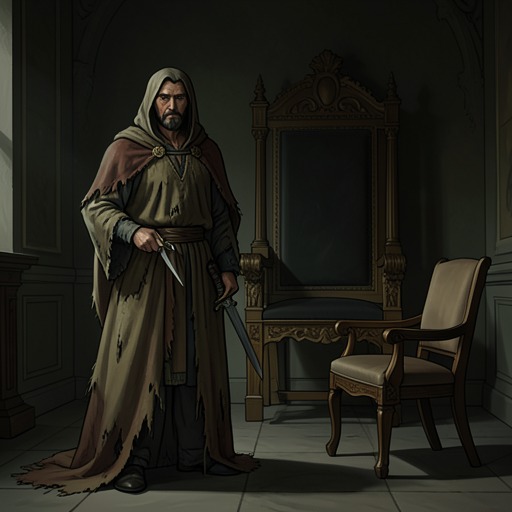
Darilth and Keralth’s Throne-room Duel
The Vampire Prince’s BrideDarilth and Keralth’s Throne-room Duel is the turning point that converts a succession crisis into a public judgment. Darilth enters the throne room not merely to challenge his half-brother, but to reclaim the legitimacy Keralth tried to seize through murder, manipulation, and the theft of the Draco’s Eye. The encounter joins a physical sword fight to a carefully prepared political trap: Darilth provides the authority and combat strength, while Merelith preserves the evidence that makes Keralth’s defeat legally undeniable.
Causes and Preparation
Darilth approaches the confrontation after recovering enough strength to act, wearing a black leather hooded military trench coat and black leather pants. He straps on Lazarus, the sword preserved by his family for centuries, and checks the Draco’s Eye at his wrist. The Eye is silently healing his wounds, allowing his strength to return quickly before the dangerous mission. He then pulls on his dark cloak and leaves for the waiting spacecraft.
Merelith accompanies him to Iovis, and the journey takes almost two days. Their method depends on concealment rather than an open royal procession. Merelith disguises herself as a royal concubine, wearing a crimson low-cut, backless gown and allowing her long dark hair to fall freely. Through magic, she changes her face so Keralth will not recognize her. Darilth follows in the role of her servant and protector, his hood drawn low. The disguise brings them close enough to Keralth for Merelith to create the opening required for Darilth’s intervention.
The plan also includes a form of testimony. Merelith carries a small circular disc containing Keralth’s full confession, and the council is already listening to the recording while the confrontation unfolds. The duel therefore has two simultaneous stakes: Darilth must survive Keralth’s weapon, and the hidden evidence must reach the council before Keralth can deny his crimes or use the throne room’s authority against them.
Confrontation in the Throne Room
Keralth sits on the throne looking bored when Merelith approaches and kneels before him. He orders the guards and his men to leave them alone, apparently believing that the supposed concubine poses no threat. He claims that the king’s gift has arrived too late because the king is dead, then approaches Merelith with predatory interest. His confidence rests on the assumption that he controls both the room and the political situation.
Darilth breaks that assumption by stepping forward with Lazarus drawn and pointing the sword at Keralth’s throat. He pulls back his hood and identifies himself through his presence before the surrounding guards can react. Keralth responds with contempt, mocking Darilth for supposedly keeping whores after his mate became sick. Merelith rejects the insult and turns back to her true form, completing the reversal of the disguise: the figure Keralth treated as disposable has been the architect of his exposure.
Keralth demands the Draco’s Eye, insisting that surrendering it would end the conflict. Darilth refuses, stating that the Eye does not belong to Keralth and declaring that Keralth will be exiled to the Dark Moon as punishment. The declaration establishes the duel’s central moral and political contrast. Keralth treats the Eye as an instrument of possession and power; Darilth treats it as an inheritance that cannot be legitimized by seizure.
The Sword Fight and Confession
Keralth attacks first, lunging with his sword. Darilth parries the blow easily, but the fight quickly becomes a dangerous exchange rather than a symbolic victory. Keralth reveals that he had nearly taken the throne after the old king rejected the human woman associated with Darilth and kept Darilth in exile. He blames Darilth for disrupting that plan and claims that he is better suited to rule.
Darilth wounds Keralth’s arm with a deep gash, while Keralth cuts across Darilth’s chest and draws dark blue blood. The injuries make the conflict physical and immediate, but Keralth’s words make clear that the duel is also an argument over succession. Keralth describes the old king as senile and insists that Darilth was never meant to inherit, using Darilth’s long delay in finding a mate as further evidence of supposed unfitness. His ambition is inseparable from contempt for both the old king and Darilth.
The decisive revelation comes when Keralth confesses that the old king’s reaction to the awakening of the Draco’s Eye led him to consider making Darilth king. Keralth says that he therefore had to finish the old king off. The confession confirms that the succession crisis was manufactured through patricide, not caused by the old king’s incapacity or by Darilth’s failure to qualify. Darilth answers that their father trusted Keralth and that Keralth betrayed him, identifying the crime as both familial treachery and a violation of royal trust.
As Keralth continues swinging, madness overtakes him. Darilth changes position, backs him toward the nearest wall, and parries and attacks until the balance of the fight is complete. He finally pins Keralth against the wall with Lazarus at his throat and announces that the conflict ends there. The physical restraint matters because Darilth does not need to kill his brother to establish victory; Keralth’s own spoken admission and Merelith’s recording can now transform defeat into judgment.
Arrest and Immediate Consequences
At Darilth’s signal, Merelith raises the disc and explains that the council is listening to Keralth’s full confession at that moment. Her evidence prevents the confession from disappearing into the chaos of the duel and makes Keralth’s words part of a wider political record. Darilth thanks her, then calls for the guards.
The guards initially appear confused to see Prince Darilth in the throne room, but his command is clear: Keralth is to be arrested immediately and sent to the Dark Moon. Keralth is removed alive, deprived of the throne he tried to claim and subjected to the punishment Darilth announced before the fight. The outcome is therefore both a personal defeat and an institutional correction, with the guards and council positioned as witnesses to the restoration of lawful authority.
Darilth pays a heavy physical price. After Keralth is taken away, he collapses because he is too weak to remain standing. His chest wound is deep, and a throbbing headache pounds at his temples. Merelith discovers that Keralth’s sword was poisoned, adding a concealed method of assassination to the visible violence of the duel. Darilth survives because Merelith instructs him to concentrate on the Draco’s Eye; within minutes, its power heals the gash and restores his strength.
Narrative Significance
The duel combines the plots of rivalry, discovery, and restoration. Its revelation is not supplied by an outside investigator: Keralth’s ambition forces him to narrate the crime himself while fighting the person whose inheritance he tried to destroy. That structure makes his arrogance the mechanism of his exposure. He wants to justify his claim to rule, but every explanation instead confirms the old king’s murder and his own betrayal.
Merelith’s role prevents the confrontation from becoming a simple contest of male force. Her altered appearance creates the access point, her transformation exposes Keralth’s contempt, and her recorded evidence ensures that victory will survive beyond the room. Darilth’s sword, the family weapon Lazarus, represents inherited legitimacy in material form, while the Draco’s Eye represents a living inheritance that heals him after the institution of justice has been secured.
The ending also completes a return from exile. Darilth arrives concealed as a servant and leaves the throne room as the prince who can command Keralth’s arrest. His authority is not restored by proclamation alone: it is tested through combat, verified through confession, witnessed by the council, and confirmed by the guards’ obedience. The throne-room duel thus changes the political meaning of Darilth’s return. He is no longer merely the excluded heir whose status depends on the old king’s intentions; he becomes the surviving claimant who has exposed the usurper and reclaimed the future of the Rothgar line.